 |
 |
 |
 |
 |
 |
 |
 |
 |
 |
 |
 |
 |
 |
 |

Showing posts with label Aircraft. Show all posts
Showing posts with label Aircraft. Show all posts
20151203


20121126
20120812
P-38
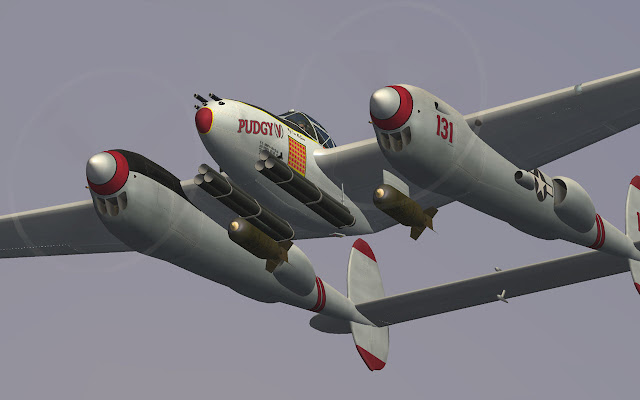
I don't want to rewrite the Wikipedia article on the P-38, just sharing some pictures. I think it is a beautiful aircraft, and have some new found interest in flying it on Aces High II. It seems to fit in to so many roles and has far more upside's than down. It is a plane, at least in the simulation, that requires patience -- the Porsche of WWII aircraft, "...it does not suffer fools gladly." The power and the firepower more than make up for the short comings in maneuverability and speed. Even in the late war arena it can more than hold it's own.




Pictures:


Videos:

20120726
Weekly Update 00

# Starting new weekly updates on the blog. This will have tags so that it should be easy to follow along in the conversion. If we start getting a lot of participation I will make time to move it to my server and add forums and pic galleries for each member, videos, etc. I just want to make sure that we have enough usage to justify moving the project to that level. We got 500+ views this month, and seem to be drawing more of a crowd, even though the blog has been largely inactive in the last few years -- so that fills me with a bit of hope. I am going to be posting the videos on my YouTube channel and monetizing it for the purpose of posting larger videos and in hopes that it will contribute to web hosting costs.

# We are moving to C3 http://www.downloadc3.com/ for in game chat. We will then most likely be using the in game chat system for recruiting and event communication only. As we realize that some of our members machines may lag a bit from running both the game and the chat system -- though more than likely it will be just fine-- we will be moving to the new system over time, as to lessen the technical and financial impact on everyone. If you don't already have at-least an entry level video card (http://guru3d.com/news/nvidia-entry-level-cards-gt-610-620-630/), and a multi-threaded processor (http://www.sharkyextreme.com/guides/MVGSBG/article.php/3939851/PC-Buyers-Guide-for-EntryLevel-Gaming--April-2012.htm), you are going to want to think about upgrading in the coming year. This will ultimately make your experience better, no one likes to lag about. All the information that you need about the system should be on the c3 site and forums. Google any issues that you have, if you still have issues you can get a hold of me and we can walk through it.

# I will be starting a Facebook page, Google Plus account, and Twitter account linked with the blog and the web-page so that everyone can keep track of things the way they want to. You can subscribe to the blog using your choice of feed readers, though I suggest Google Reader. Today I started a Picasa-Web account connected to this blog so that we can post longer videos, and lots of screenshots without breaking things later if we need to move the blog to another host.
20100203
Air to Ground Attacks in WWII
TANKBUSTERS: AIRBORNE ANTI-TANK GUNS IN WWII
 Image via Wikipedia
 © Anthony G Williams This summary is based on material from 'Flying Guns: World War 2' by Emmanuel Gustin and Anthony G Williams
Amended 24 June 2004
The advent of highly mobile tank warfare at the start of World War 2 prompted a search for ways of destroying tanks from the air, with variable success. There was a preference in some quarters for using fighter-bombers armed with rockets or bombs, but while these were effective in general ground attack, including disrupting supplies to armoured units, they proved largely ineffective in directly knocking out tanks for the reasons spelled out in 'Flying Guns: WW2':
" The ineffectiveness of air attack against tanks should have caused no surprise because the weapons available to the fighter-bombers were not suitable for destroying them. Put simply, the heavy machine guns and 20 mm cannon were capable of hitting the tanks easily enough, but insufficiently powerful to damage them, except occasionally by chance. The RPs and bombs used were certainly capable of destroying the tanks but were too inaccurate to hit them, except occasionally by chance."
Experience showed that the best way of knocking out tanks was to use a cannon powerful enough to penetrate the armour. This article examines the weapons used and takes a retrospective look at an 'ideal' airborne anti-tank armament.
"The Gun Carriers: what of the aircraft?"
There were various possible locations for heavy cannon, but they all boiled down to two basic types - wing or fuselage mountings. Wing mountings had several disadvantages. First, they suffered the usual problems with this location of harmonisation; that is, the guns had to be angled inwards to coincide with the sight line, and this could only be for a specified distance. At much shorter or longer distances, the projectiles would not strike where the sights were aimed. Incidentally, it is worth mentioning that with all guns, wherever mounted, there was also a vertical harmonisation issue, in that projectiles followed a curved trajectory so at much shorter or longer distances they would strike above or below the aiming point. However, this would be much less of a problem with a high muzzle velocity. Other disadvantages of wing mounting peculiar to heavy cannon were, obviously, that the weight and drag penalties were much greater than with one fuselage-mounted gun, the wings were more flexible not just in flight but also under recoil (which affected accuracy) and the plane could be moved from side-to-side by the recoil if the guns fired at different instants, further affecting accuracy. The guns were also mounted under the plane's centre of gravity, which meant that recoil pushed the nose down on firing.
All of this added up to less accuracy and lower aircraft performance with wing-mounted cannon. This is significant because most single-engined aircraft fitted with large cannon had no option but to fit them under the wings, as few vee-engines, and no radials, were compatible with the engine-mounting of the gun. In theory, a gun could be mounted under the belly of the plane and synchronised to fire through the propeller disk, but in practice this became more problematic as the size of the cartridge case increased because of the variations in the burning time of the propellant (the Luftwaffe considered but rejected such an installation of the MK 103 in the Fw 190 for this reason).
Of course, none of these problems bothered twin-engined aircraft, which were able to employ a rigid central mounting in or under the fuselage, directly under the sights, to the great benefit of accuracy. They also usually had a much better forwards and downwards view (important for a ground attack plane), although blocked to the side by the engines. However, most twins were much bigger than singles, making them much bigger targets for ground fire. Attempts to use Ju 88s in the anti-tank role led to catastrophic loss rates. The only exception was the Hs 129, a very compact plane. However, while that was probably the most effective of all the anti-tank aircraft, it had a low performance and was relatively helpless against enemy fighters, not even having the benefit of a rear gunner.
.... Wing area is an indicator of apparent size, and therefore the risk of being hit by ground fire (although for a given wing area, twin-engined planes usually presented a bigger target). Wing loading is a double-edged sword: a low wing loading was useful for a good short-field performance and low-speed manoeuvrability, but a smaller wing was less disturbed by low-level air turbulence and therefore (other things being equal) was likely to provide a more stable gun platform for ground attack. The power loading (as with the wing loading, taken at maximum loaded weight) gives an indicator of performance. ...
Link to the full article -- Tankbuster Aircraft of WWII
![Reblog this post [with Zemanta]](https://lh3.googleusercontent.com/blogger_img_proxy/AEn0k_s5RMAWB09AeLOxtxFrz0LJkVWR95Ye2uhx8lyst9X_8joRO-yTzs_q6qeuAs8_7ZUDtGQMJGuVTfQA1IKSYtPpg8zgAH2QdJH-AB6eZV-mrJg8fk6WwMGR40aEVMZlr31EkQ-CGwwNUDk4pHdhHrqg=s0-d)
Subscribe to:
Posts (Atom)